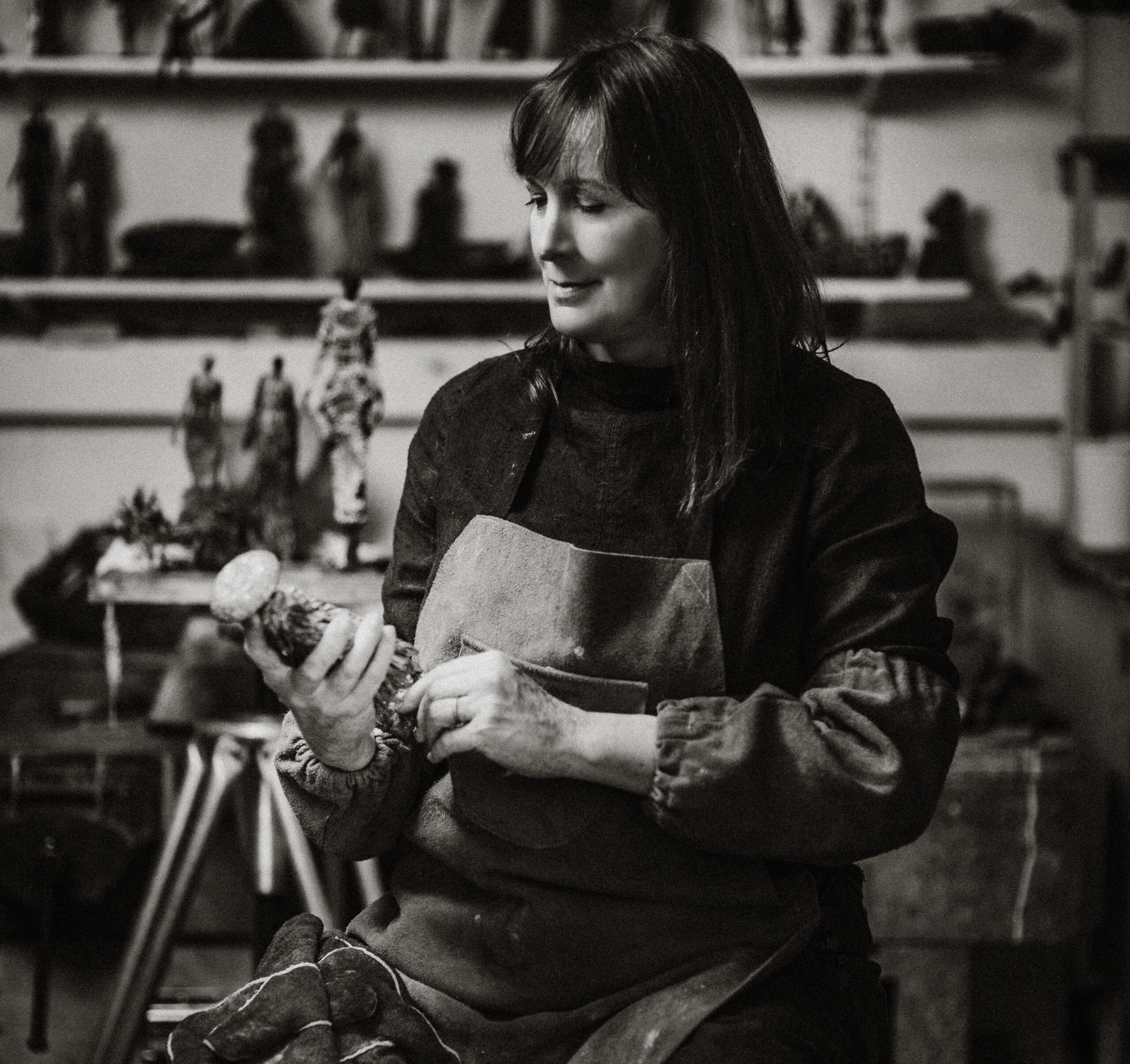
Courtesy of Robyn Neild
There are artists who shape matter, and there are artists who shape memory. Robyn Neild does both.
Her journey began not with bronze, but with the fleeting lines of fashion illustration — gestures on paper capturing the weightlessness of silk, the drama of a silhouette poised between movement and stillness. Over time, the page could no longer contain her vision. Those lines, once ephemeral, sought permanence, and so they became sculpture.
Her bronzes, delicate yet unyielding, stand at the threshold between fashion and eternity. They carry within them the discipline of Haute-Couture — the meticulous craft, the reverence for detail, yet speak in a language older than fashion itself: the language of myth, beauty, and the human form as poetry.
This language has found its way into the worlds of Stephen Jones, with his architectural millinery; Harris Reed, whose romantic fluidity reshapes modern elegance; the timeless codes of Chanel; and the avant-garde spirit of Schiaparelli. Alongside these collaborations, Robyn’s work has appeared across the pages of some of the world’s most celebrated fashion publications, where illustration and narrative converge to capture the soul of couture.
In translating this spirit into sculpture, Robyn captures not only the silhouettes of couture but its very essence: the tension between fragility and strength, ephemerality and permanence. Her studio, much like the ateliers of haute couture, becomes a sanctuary where countless hours give birth to moments of wonder where a gesture in clay becomes a meditation on femininity, resilience, and the quiet grandeur of art itself.
You began your creative journey as a fashion illustrator, working with prestigious publications such as Vogue, Elle, Glamour, Tatler Magazine and later for iconic retailers like Harrods and Liberty. How did these early experiences shape your understanding of narrative, movement, and the human form, and how do they continue to influence your sculptural practice today?
RN – Working with fashion magazines, fashion stores and drawing at London & Paris fashion weeks trained my eye to capture movement, elegance, and the psychology of clothing on the body. Illustration demanded a narrative in a single gesture — how fabric falls, how a silhouette holds power, how line conveys emotion. That sensibility never left me. In sculpture, I translate that same fluidity into bronze: each curve or fold feels like drawing in three dimensions.
Your transition from illustration to sculpture introduced a new dimension to your storytelling. Can you describe how your experiences with fashion design and editorial work inform the textures, forms, and presence of your bronzes?
RN – In fashion, texture and silhouette are everything. That has carried directly into my bronzes, where surfaces hold the memory of plants, roots, or textile-like imprints. My editorial background gave me an instinct for drama — a sense of presence. Sculpture allowed me to extend that, giving these forms permanence and weight, yet keeping a sense of lightness in how they occupy space.
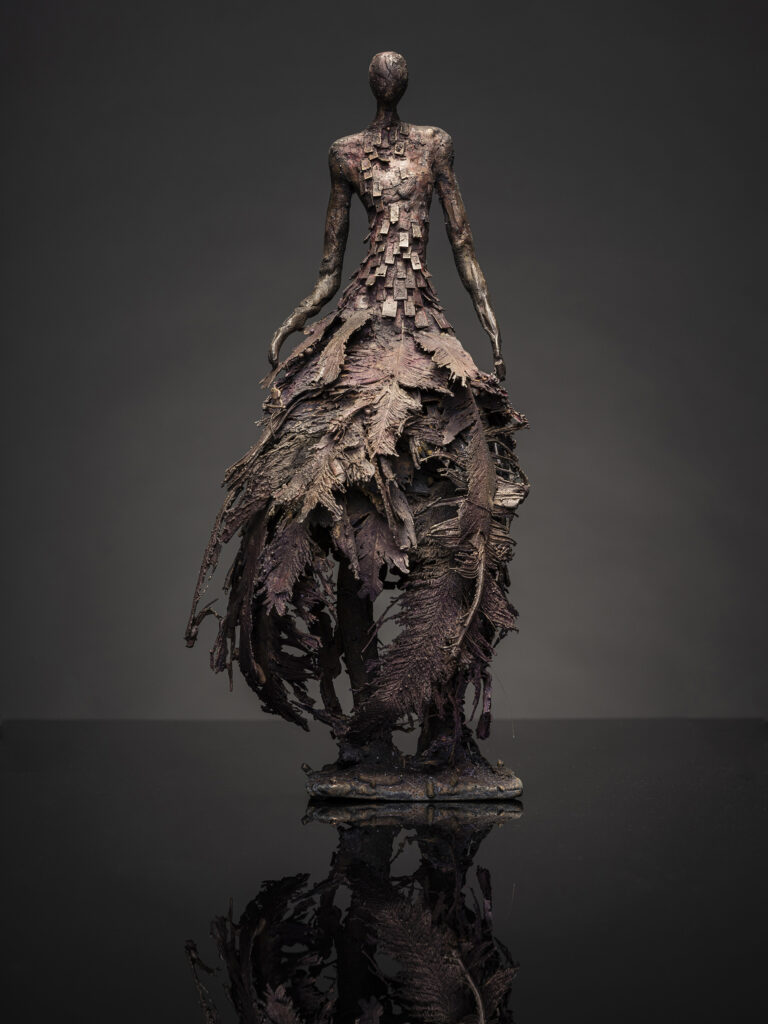
Bronze reinterpretation of Alexander McQueen’s from VOSS, Spring–Summer 2001 – Courtesy of Robyn Neild
You have created sculptures inspired by, or in dialogue with, renowned fashion houses such as Chanel, Dior, Alexander McQueen, Vivienne Westwood, Harris Reed, Iris Van Herpen, etc. How does interpreting fashion as three-dimensional art influence your creative process, and what unique challenges or inspirations does this collaboration bring?
RN – Fashion offers an extraordinary archive of ideas about identity, ritual, and transformation. Translating couture into bronze is not about imitation but about dialogue — what happens when fabric becomes metal, when a silhouette becomes a relic. Each collaboration or inspiration — whether McQueen’s theatre, Dior’s elegance, or Iris van Herpen’s futuristic forms — challenges me to distill the essence of couture into timeless material.
Your work often incorporates natural materials — foraged plants, driftwood, and organic textures — alongside bronze. How does this interplay between ephemeral and permanent materials contribute to the narrative and emotional resonance of your pieces?
RN– The plants, roots, and organic fragments I gather are fleeting, fragile seasonal remnants. Casting them into bronze preserves both their ephemerality and their endurance. This tension is central to my work: a weed plucked from a field might live forever when cast in metal, carrying its history of fragility and resilience. In this way, the natural world becomes both memory and transformation — a means of mimicking the opulence and embellishment of couture through the quiet intricacy of growth.
Many of your sculptures play with negative space, delicate voids, and subtle interruptions in form. What do these “gaps” represent conceptually, and how do they shape the dialogue between fragility, strength, and presence in your work?
RN – The voids in my sculptures are as important as the solid forms. They speak of absence, breath, and the spaces between things — what is unsaid, what is lost, or hope of what might emerge. For me, fragility and strength live side by side, and those gaps allow the figure to feel both vulnerable and powerful, dissolving and present at once.
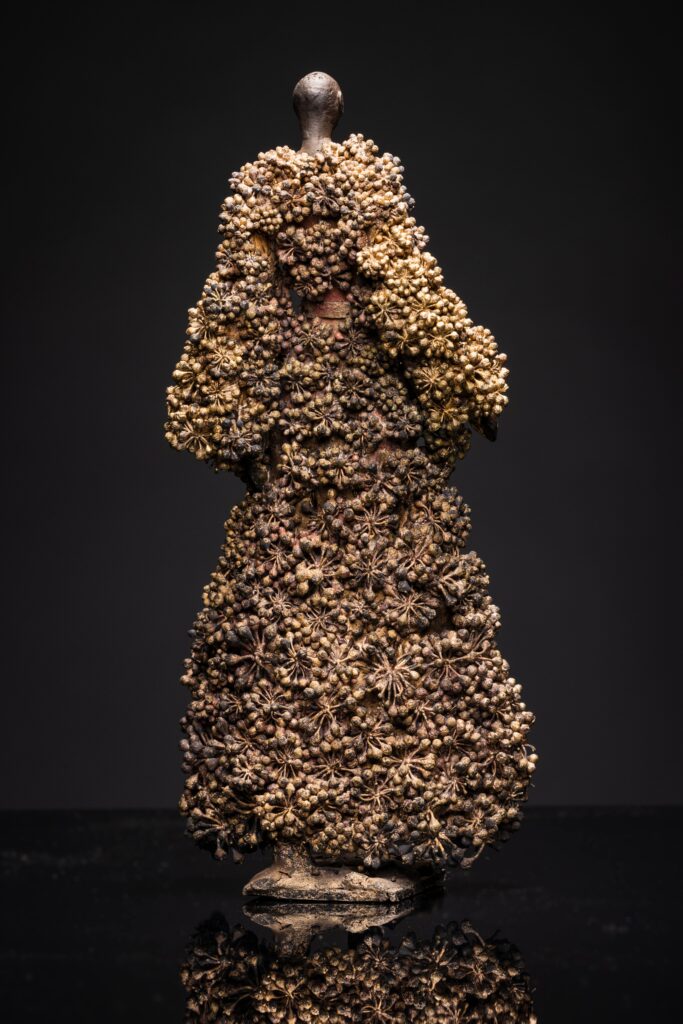
Bronze sculpture inspired by Chanel: Courtesy of Robyn Neild
The human figure recurs in your sculptures, often with an elegant balance of tension and grace. How do you approach capturing both the physicality and the emotional or mythological dimension of the body?
RN – I approach the body less as anatomy and more as archetype, be it the heroine, warrior or beast of the forest — a vessel of myth, emotion, and presence. The elegance and restraint in posture echo fashion illustration, but the tension in form hints at deeper stories. My figures are not portraits; they are embodiments of states of being — poised between strength, grace, and fragility.
Haute couture is both ephemeral and meticulously crafted, much like your bronzes, which balance permanence with delicacy. In what ways do you see your practice reflecting the spirit of couture — the precision, the poetry, and the emotional resonance behind each creation?
RN – My practice also is obsessive in its attention to detail, yet fleeting in its inspiration. Both couture and bronze sculpture embody transformation — from raw material to something charged with spirit. The precision, the craftsmanship, and the poetry in each couture garment mirror what I strive for in my bronzes: timeless objects infused with emotion.
Your sculptures often draw inspiration from the intricate craftsmanship, textures, and silhouettes seen in haute couture. How does the discipline and artistry of couture influence the shapes, detailing, and narrative of your work?
RN – The silhouettes of couture often become the armature of my imagination — defined torsos, dramatic skirts, or exaggerated shoulders find echoes in my bronzes. But it’s the detailing — the small embellishments, the surface treatments — that feel closest. Just as couture artisans layer, stitch, and bead, I layer textures from nature, building complexity into each piece.
Looking forward, do you envision your sculptural practice engaging further with fashion, architecture, or other forms of design? How do you imagine expanding the dialogue between your artistry and the world of contemporary creative expression?
RN – I see sculpture as porous, always in conversation with other disciplines. Fashion has been a natural dialogue, but I’m increasingly drawn to architectural structures and installation — creating environments rather than objects. I imagine my practice expanding into spaces where sculpture, fashion, and design intersect: immersive works that transform how we move through a room or how we experience the body in space.
As Haute- Couture designers present their visions to the world during fashion weeks, how do you perceive the dialogue between your sculptural practice and this universe of luxury fashion? Do you see your work as complementing, interpreting, or inspiring the narratives created on the runway?
RN – Couture shows are theatre, temporary yet unforgettable moments. My sculptures share that duality: they embody drama but exist beyond the season. I see them as both complementing and interpreting the runway: echoing the spectacle, but distilling it into something elemental, lasting, and contemplative.
Looking toward the future of your art in relation to haute couture, what lasting impression or emotional resonance do you hope your sculptures impart to those who experience them — the same awe inspired by couture, or a more intimate reflection of artistry and human expression?
RN – I hope my sculptures leave behind not just awe, but intimacy, a sense of recognition that lingers. Couture inspires wonder, but I want the work also to reflect something more personal: the fragility of the body, the resilience of nature, the poetry of transformation. If viewers feel both transported and grounded, then I’ve achieved the resonance I seek.
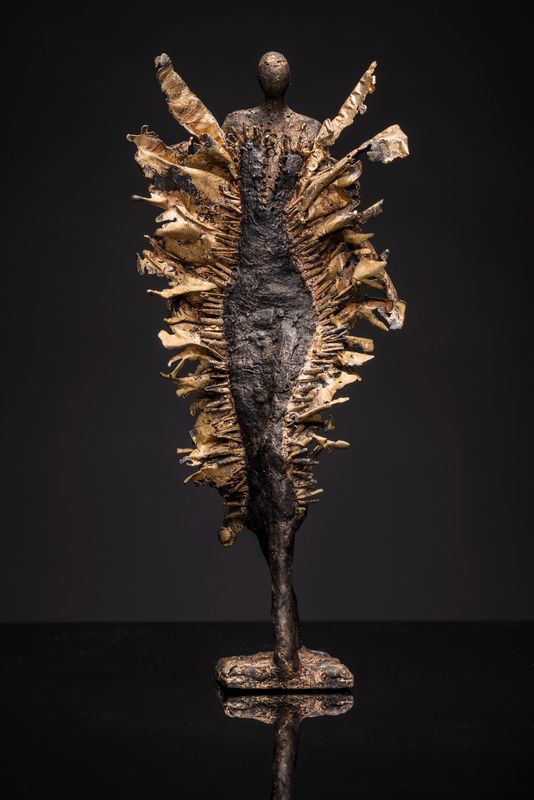
Bronze sculpture inspired by Schiaparelli — Daniel Roseberry, Back to the Future: Courtesy of Robyn Neild