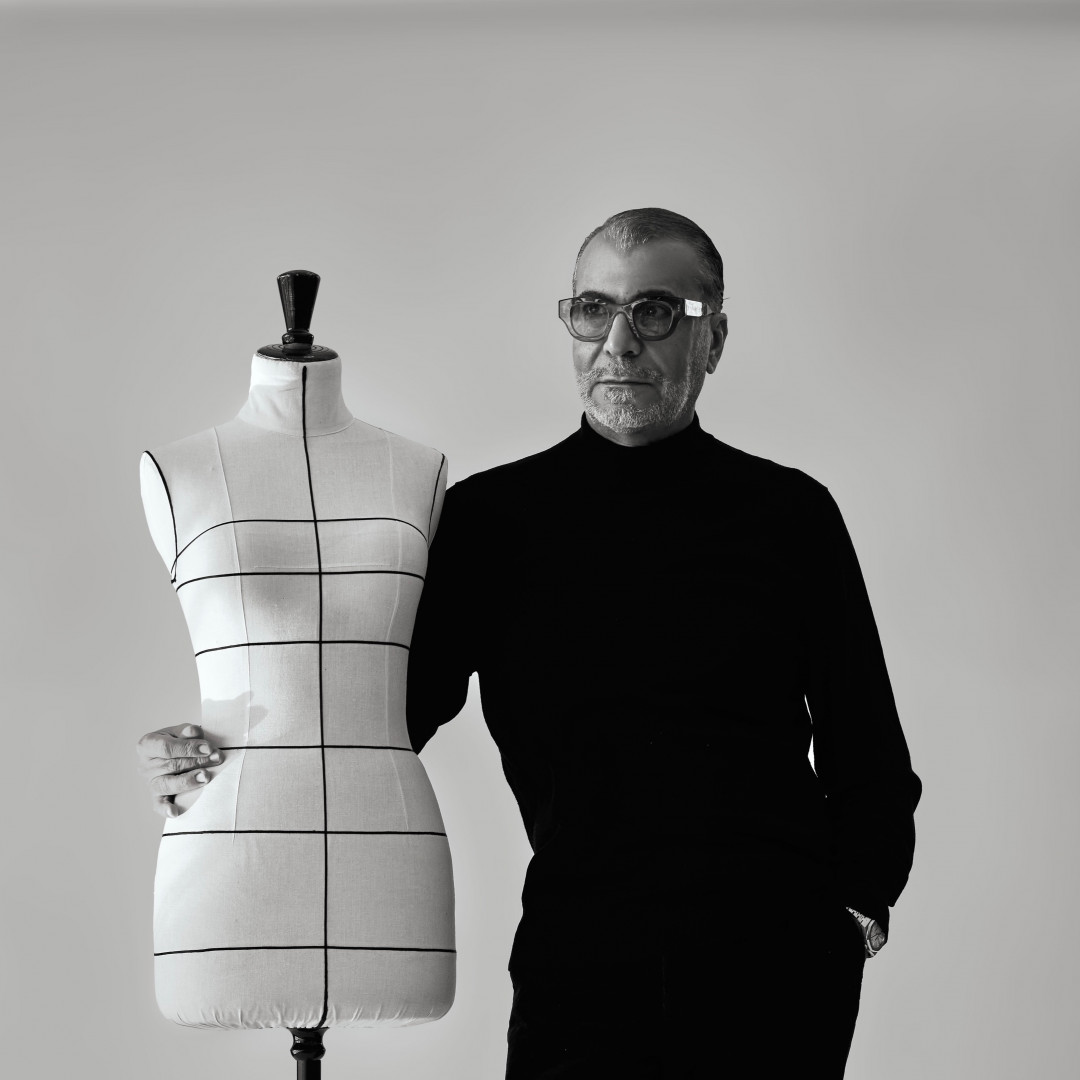
Georges Chakra —“What makes couture timeless is not only the garment, but the emotion and the story attached to it.”
Courtesy of Georges Chakra
In Haute–Couture, creation rarely begins with fabric alone. It begins with memory — with places, gestures, and the quiet inheritance of culture that shapes the sensibility of the designer long before the first sketch is drawn. For decades, Georges Chakra has cultivated a vision of glamour that moves between worlds: the vibrant cultural depth of Beirut and the enduring elegance of the Parisian couture tradition. Within this space between origins and evolution, his work has developed a language of sculptural femininity, luminous craftsmanship, and a refined sense of presence that has come to define the Maison’s identity.
Over time, this vision has extended far beyond the runway, shaping a cultural dialogue in which glamour becomes more than an aesthetic gesture. It emerges as a form of expression — an emotional architecture through which elegance, strength, and sensuality coexist. Each collection becomes a continuation of this narrative, a moment where heritage and modernity encounter one another through the discipline and devotion of the atelier.
With the Spring–Summer 2026 Haute Couture collection, Georges Chakra revisits the language of the house with renewed clarity and quiet audacity. Drawing from the Maison’s heritage while embracing a contemporary sensibility, the collection reimagines past sartorial codes through the lens of a new Parisienne attitude — confident, effortless, and deeply modern. In this vision, glamour is neither nostalgic nor excessive; it becomes a refined expression of presence, where structure, light, and movement converge to create silhouettes that feel both timeless and unmistakably of the moment.
In this exclusive interview with The Runway Source, Georges Chakra reflects on the philosophy behind the collection, the deeper emotions that guide his creative process, and the enduring relationship between heritage, intuition, and the evolving language of couture.
The Spring–Summer 2026 collection revisits the language of glamour through a contemporary lens. At the very beginning of the creative process, what inner idea, emotion, or reflection first gave birth to this collection?
GC: For this collection, I was thinking a lot about clarity. I wanted to return to the essence of the house, but in a way that feels lighter and more effortless. There was this idea of glamour without heaviness, and I did not want excess for the sake of excess. Every detail, volume, and embroidery had to have purpose.
Throughout your work, femininity appears both powerful and luminous. In this collection, the silhouettes seem to embody a renewed confidence — what does this “Parisienne attitude” represent to you beyond style, perhaps as a state of mind or philosophy?
GC: For me, it goes beyond style. It is really about the spirit of Paris itself, the culture, the energy, the joie de vivre. There is this effortless relationship with beauty in Paris. People appreciate details, art, elegance, but it’s very natural. I wanted the collection to reflect that balance between refinement and ease, and for the glamour to feel spontaneous instead of constructed.
Haute-Couture often carries the invisible weight of memory. While creating this collection, did you feel more connected to the heritage of the Maison, or to the desire to reinterpret and transform it for the present moment?
GC: Heritage is always there naturally as part of the house. For this collection, I revisited many of the codes that have existed throughout the collections, but I wanted to make them feel different, more in tune with today. We worked a lot on volume and construction, creating pieces that feel strong but still effortless. There are also references to historical couture shapes, but interpreted in a more modern and relaxed way. It was really about taking the essence of the house and pushing it forward.
Your designs possess a remarkable balance between structure and fluidity, almost as if the garments breathe with the body. How do you approach this dialogue between architectural form and natural movement when shaping a couture silhouette?
GC: I always think about movement first, even when a piece is very structured. Couture should never feel static or uncomfortable. A lot of it comes from construction and from the work done inside the garment that people do not see. The balance is important because structure gives presence and posture and the fluidity gives emotion. When the two work together, the silhouette feels natural and powerful.
Your creative universe exists between Beirut and Paris, two cities with profoundly different rhythms and cultural energies. In what ways has your Lebanese heritage shaped your understanding of elegance, glamour, and beauty?
GC: Beirut and Paris have both shaped my work in very different ways. Beirut gave me drive, discipline, joy, and a strong sense of individuality. I could go on forever about Lebanon, but there is real intensity and determination in the city that naturally became part of the way I approach my work. Paris brought charm and the culture of couture itself. I think the house exists somewhere between these two energies, and together they shaped my vision of glamour and couture.
In many ways, haute couture transcends fashion and enters the realm of art. Do you see the act of creating couture as a form of storytelling, or perhaps even as a spiritual search for beauty?
GC: Yes, absolutely. Couture is emotional. It is not only about clothing. Every collection tells a story about women, beauty, craftsmanship, and sometimes even about the moment we are living in. There is also something very human about couture because it is made by hand, slowly, with patience and devotion. In a way, it is a search for beauty, but also for meaning and emotion.
The Spring–Summer 2026 collection feels both audacious and serene, as though strength and softness coexist within the same gesture. How do you navigate these dualities when shaping the emotional landscape of a collection?
GC: I never like when something feels too rigid or too soft. In this collection, there are strong architectural elements, but they are balanced with transparency and lightness. Even the construction was approached that way, volumes that feel controlled but still effortless, embroidery that has structure but is also fluid. That tension between strength and softness is what gives the silhouettes life.
In an era defined by acceleration and constant change, couture remains one of the few spaces where time slows down and craftsmanship is honored. What does this slower rhythm of creation represent for you as a designer?
GC: Couture reminds us of the value of time and the art of human artisanal work. The embroidery, the fittings, the construction, everything requires time and attention. That slower rhythm creates a real focus on emotion and quality, and it reminds people that couture is not rushed, it is thoughtful, carefully made, and meant to last.
Over the decades, your work has remained unmistakably glamorous while continuing to evolve with the present. How do you preserve the soul of the Maison while allowing it to transform with time?
GC: The soul of the house is always there because it comes from instinct and from a very personal way of looking at the world. In the end, evolution is necessary. Fashion changes, culture changes, and the way people perceive the world changes as well. What I find challenging is staying authentic while still moving forward and exploring new ideas. I never want the house to repeat itself, but I also never want it to lose its identity. At the same time, I am constantly inspired by previous archival collections and by the history of the house itself.
When a woman wears one of your couture creations, what emotion or inner transformation do you hope she experiences in that moment?
GC: I hope she feels good in it, really. Couture is something very personal, so every woman experiences it differently. But when someone feels comfortable and confident in what they are wearing, you can immediately see it in the way they carry themselves, the way they move, the energy they give off. That natural sense of confidence and ease is very important to me.
Haute couture has long transcended the boundaries of fashion, existing at the intersection of art, philosophy, and human expression. In your view, what does couture ultimately reveal about beauty, identity, and the human desire to create something timeless?
GC: I think couture reveals something very human, the desire to create things with meaning, emotion, and permanence in a world that feels temporary. Couture is not only about beauty, it is about memory and the value of creation itself.
What makes couture timeless is not only the garment, but the emotion and the story attached to it. Long after a collection, people still remember how a piece made them feel, or the moment in life connected to it. Very often, pieces are passed down through generations. For me, that is what gives couture its depth and why it continues to exist beyond fashion alone.