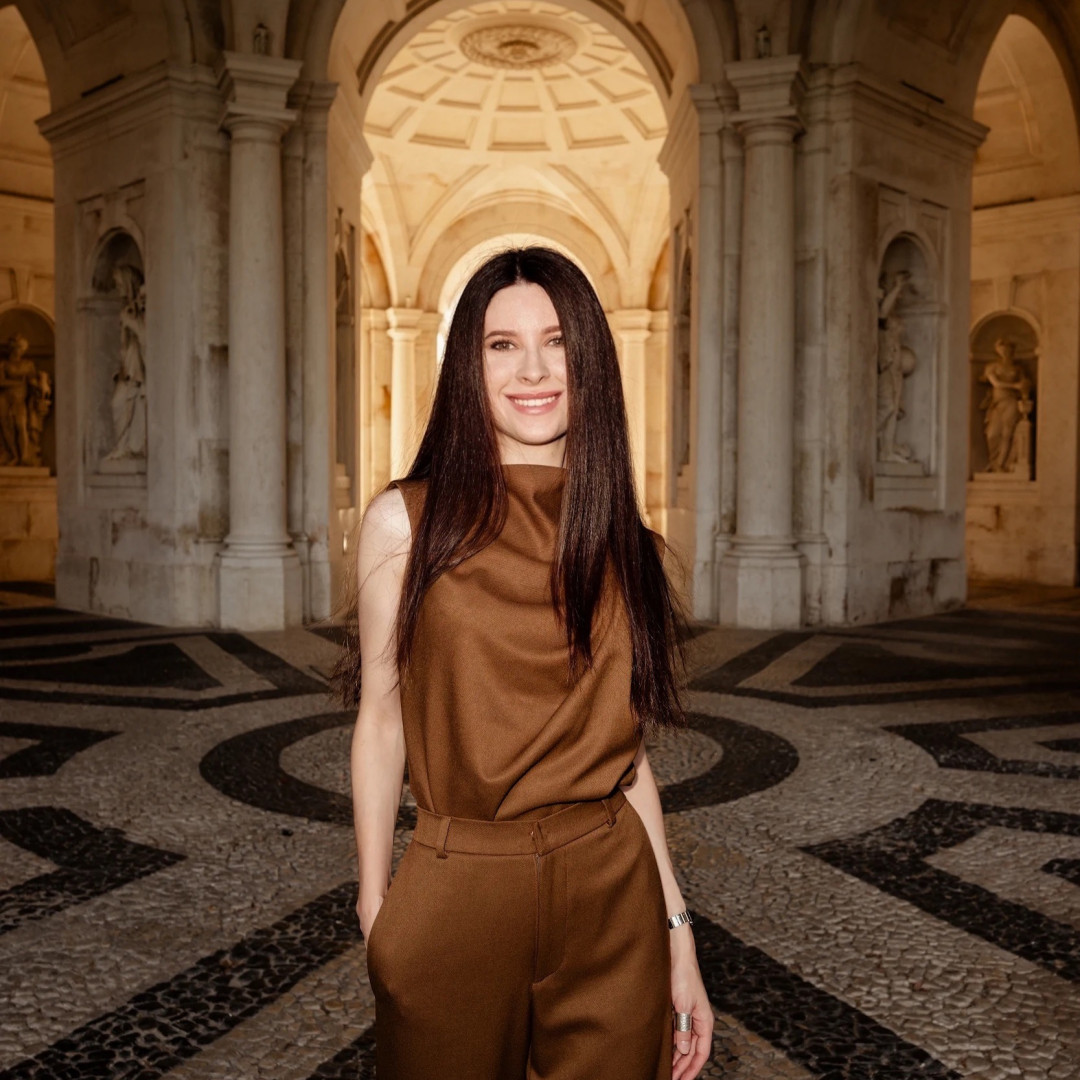
Khrystyna Kurliak – “No matter how many images surround us, the desire to experience something genuine never disappears“
Desire exists prior to form, prior to language, and prior to the object itself. It operates as an invisible architecture of anticipation, a psychological field in which meaning is already active before it becomes visible.
Within the universe of Khris K, desire is not positioned as a reaction to fashion, but as one of its generative conditions. It is not a consequence of imagery, but the precondition that allows imagery to carry emotional weight.
In conversation with Khrystyna Kurliak, desire emerges as a structural inquiry into how beauty is internally composed, long before it is translated into silhouette, material or form.
This interview does not attempt to define desire as a stable concept. Instead, it approaches it as a continuous state of negotiation between absence and recognition, where longing becomes both the origin and the residue of creation.
Why do you think human beings continue to long for beauty, even in a world saturated with images where almost everything has already been seen?
KK: I think beauty is something deeper than an image. We may feel that everything has already been seen, but emotions are never repeated in exactly the same way. People continue to seek beauty because they are searching for connection, inspiration, and meaning.
For me, beauty is not perfection. It is a feeling that reminds us we are alive. Sometimes it appears in a silhouette, sometimes in nature, and sometimes in a simple human gesture. No matter how many images surround us, the desire to experience something genuine never disappears.
Perhaps that is why beauty remains timeless. We are not searching for something new as much as we are searching for something real that speaks to us personally.
When you create for Khris K, do you feel that you are designing garments, or are you constructing emotional states that later become garments?
KK: I always begin with an emotion rather than a garment. It can be a feeling, a memory, a question, or a moment that stays with me and asks to be expressed.
The garment comes later as a way to give that feeling a physical form. Through fabric, silhouette, and craftsmanship, something invisible becomes visible. In that sense, I am not only designing clothes; I am translating emotions into something a woman can wear and make part of her own story.
I think this is why every collection feels different. The inspiration changes, but the desire to create an emotional connection remains the same.
At what point does desire become personal for you — does it belong to you as Khrystyna, or to the identity you build through Khris K?
KK: For me, there is no clear line between Khrystyna and Khris K. The brand was born from my personal vision, experiences, and way of seeing the world. Naturally, many of the emotions that inspire my work begin with me.
At the same time, once a collection is created, it no longer belongs only to me. It starts a dialogue with other women, who bring their own stories and interpretations to it. That is the most beautiful part of creation.
What begins as something deeply personal becomes something shared. Through that process, the identity of Khris K continues to evolve and grow.
Do you ever experience a tension between what you personally find beautiful and what you believe the Khris K woman is meant to desire?
KK: Not really, because the Khris K woman was never created as a separate character. She naturally reflects many of the values and emotions that inspire me personally.
Of course, every woman is unique, and I never expect someone to see beauty exactly as I do. What interests me is creating pieces that leave space for individual interpretation. A garment can carry my vision while still becoming something personal to the woman who wears it.
For me, true beauty is not about imposing an idea. It is about creating a connection that allows each woman to recognize something of herself within it.
Can desire exist in your creative process before there is form, silhouette or material — and if so, how do you recognise it?
KK: Yes, I believe desire exists long before any sketch, fabric, or silhouette appears. It often begins as an instinctive feeling that something wants to be expressed, even before I fully understand what it is.
The creative process begins when I decide to follow that feeling and discover where it wants to lead me.
Do you see the woman who wears Khris K as someone external to you, or as an extension of an emotional or psychological version of yourself?
KK: I see her as her own person. I never design for a specific woman or create a fixed character in my mind before beginning a collection.
Of course, my creations reflect my emotions, experiences, and perspective, so there will always be a part of me within them. But once a garment is worn, it becomes part of another woman’s story, not mine. Different women may come from different backgrounds and experiences, yet they can recognize the same feeling within a piece and make it their own.
In your opinion, does beauty belong to the object, or to the emotional projection of the person who encounters it?
KK: I believe beauty exists somewhere between the object and the person who encounters it. A garment can be beautifully made, but without emotion or connection it remains only an object.
What makes beauty meaningful is the dialogue that happens between the creation and the individual. That is why the same piece can evoke different feelings in different people. Beauty is not something fixed or absolute. It becomes alive through personal experience.
How important is absence or restraint in your understanding of desire within your collections?
KK: I have never believed that my work need to be loud in order to be noticed. Sometimes what is left unsaid or unseen can be more powerful than what is immediately revealed.
In my collections, I often look for balance rather than excess. I prefer details that invite a closer look, silhouettes that suggest rather than impose, and craftsmanship that speaks quietly through its quality.
For me, desire grows through discovery. When everything is revealed at once, there is little room for imagination. A certain sense of mystery allows a garment to remain interesting and personal over time.
Do you believe that desire in fashion is resolved through possession, or does it survive precisely because it remains unresolved?
KK: For me, desire is connected to imagination, emotion, and personal growth. As we change, our desires change with us. That is why creativity never stands still and why new ideas continue to emerge.
Desire survives because it is part of an ongoing journey rather than a final destination.
When you imagine a Khris K collection, do you begin from a concept, a feeling, or a psychological necessity?
KK: Most often, I begin with a feeling. It can come from a personal experience, a memory, nature, art, music, or simply an emotion that stays with me and asks to be expressed. I rarely start with a strict concept. The concept usually becomes clearer during the creative process as sketches, fabrics, and silhouettes begin to develop. What guides me from the beginning is intuition.